
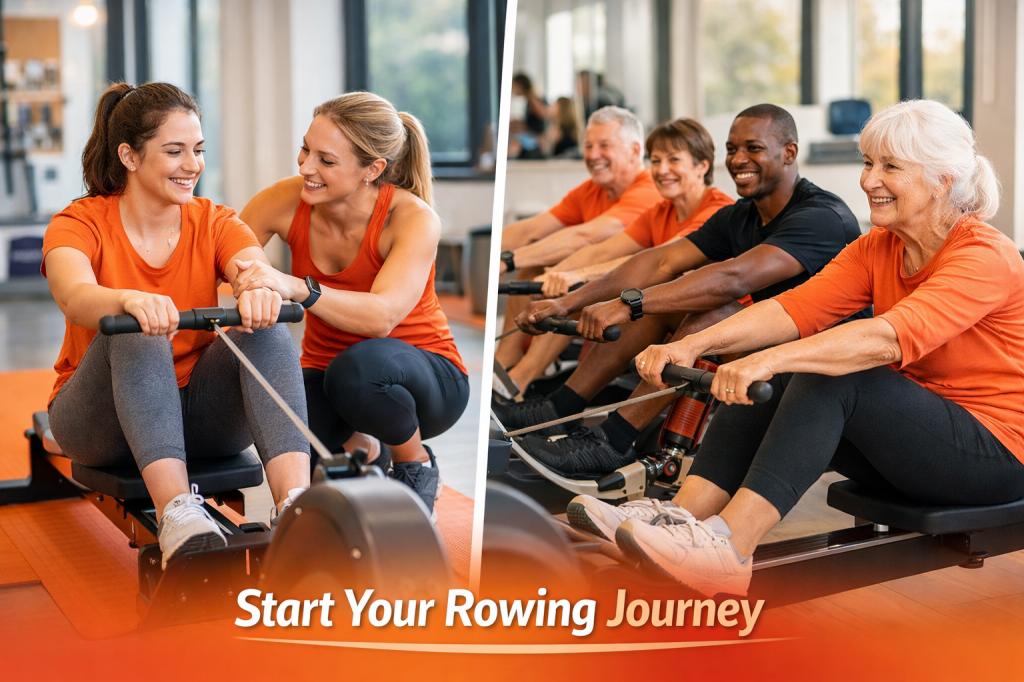
Rowing is well-known to be a uniquely effective form of exercise when used as therapy (see https://www.rowtorecoverygalway.ie/news/2/the-physical-mental-and-social-benefits-of-rowing). It combines aerobic training with full-body strength work, while remaining low-impact and adaptable for individuals of varying ages (including the elderly [1]), abilities, and medical backgrounds [2].
Benefits include improved body composition, cardiovascular fitness, joint mobility, muscular strength, and overall quality of life. Importantly, rowing also provides strong social and psychological benefits through teamwork, motivation, and the sense of belonging to a community.
What are you waiting to start? How Can You Start?
Once you have the go-ahead from your doctor, please contact our club doctor, Dr Marilyn Casha via the Club email siggiewi.rowing@gmail.com. It’s important to start slowly and work with our qualified coaches. They can help you develop proper form and technique to prevent injury and get the most out of your workout.
The Research
All this is backed by science: Exercise, in general, has long been recognized as a powerful tool for improving health, with evidence showing its role in reducing the risk of cardiovascular disease, diabetes, obesity, osteoporosis, depression, and even some cancers. More recently, exercise has been proven beneficial in supporting recovery and long-term health in people living with chronic conditions [3], including breast cancer survivors [4] [5], mental health [6], etc. A highly-cited article by Moore in the British Journal of Sports Medicine makes a strong case in favour of prescribing exercise as part of a therapeutic regimen [3]. Research also indicates that exercise can be as effective in managing numerous chronic conditions as treatment with pharmaceuticals. For example, a review of studies published in the British Medical Journal [7] suggests that the reduction in mortality associated with exercise is sometimes comparable to that achieved through medication for secondary prevention of coronary heart disease, stroke recovery, heart failure management, and diabetes prevention.
Exercise has also been shown to significantly reduce depressive symptoms in adults with diagnosed depression. This strengthens the evidence base for exercise as a therapeutic tool not only for physical recovery but also for mental health. Physiotherapists and health professionals around the world are increasingly incorporating exercise into psychiatric treatment, and rowing offers an innovative, engaging, and community-driven platform for such interventions.
What we can offer:
Our Club, with the help of APS Bank, can provide structured rowing coaching with sessions being particularly suitable for individuals living with or recovering from health challenges such as cardiovascular disease, cancer, obesity, and depression. Sessions are led by qualified coaches trained to adapt rowing exercises to each participant’s abilities and medical background. More specifically, our Rowing4Health is expected to:
- Improve participants’ physical fitness, body composition, and cardiovascular health;
- Offer a safe, supervised environment that reduces risks associated with unsupervised exercise;
- Enhance mental health and well-being by reducing depressive symptoms,
building resilience, and providing social connection.
References:
- Nied, R.J.; Franklin, B. Promoting and Prescribing Exercise for the Elderly. Am.
Fam. Physician 2002, 65, 419–428. - Restuccia, R.; Ficarra, G.; Perani, F.; Bagnato, G.; Grima, J.N.; Mannucci, C.;
Bitto, A.; Trimarchi, F.; Di Mauro, D. Beneficial Effects of Physical Activity in
Rheumatoid Arthritis Patients: Focus on Active Biomolecules. J. Orthop. Sport.
Med. 2023, 05, 168–176, doi:10.26502/josm.511500096. - Moore, G.E. The Role of Exercise Prescription in Chronic Disease. Br. J. Sports
Med. 2004, 38, 6–7, doi:10.1136/bjsm.2003.010314. - Gavala-gonz, J.; Torres-p, A.; Fern, C. Impact of Rowing Training on Quality of Life
and Physical Activity Levels in Female Breast Cancer Survivors. Int. J. Environ. Res. Public Health 2021, 18, 7188; doi:10.3390/ijerph18137188. - Real-Pérez, M.; Fernández-García, J.C.; Gavala-González, J. Effects of a 6-Month
Rowing Training Program in Breast Cancer Survivors. PLoS One 2025, 20, 1–12,
doi:10.1371/journal.pone.0317118. - Kleemann, E.; Bracht, C.G.; Stanton, R.; Schuch, F.B. Exercise Prescription for
People with Mental Illness: An Evaluation of Mental Health Professionals’
Knowledge, Beliefs, Barriers, and Behaviors. Brazilian J. Psychiatry 2020, 42, 271–
277, doi:10.1590/1516-4446-2019-0547. - Naci, H.; John, P.A. Comparative Effectiveness of Exercise and Drug Interventions
on Mortality Outcomes: Metaepidemiological Study. BMJ 2013, 347, 1–14,
doi:10.1136/bmj.f5577.
 Siggiewi Rowing Club